Showing posts with label books. Show all posts

6.24.2026

Hall of Faith Part 2

At Trinity Baptist Church, we are doing our summer study entitled "The Hall of Faith: God's Faithfulness in the Lives of Faithful People."  There are several different people teaching throughout the summer.  I had the privilege of teaching three of the first four lessons.   

This is the post about the most recent lesson I taught in this series.
Here is the other post from the other lessons: https://drodgersjr.blogspot.com/2026/06/hall-of-faith-part-1.html

Before getting into Sarah's faith, here is a spiritual discipline/prayer help.  

Pray prayers from the Bible.  There are two different ways to pray prayers from the Bible.  First,  pray what the Psalmists write, pray the prayer Jesus taught his disciples to pray, and pray the prayers Paul and other epistle writers prayed.  The second way to pray prayers from the Bible is to pray from a Bible-saturated, God-glorifying, people-loving heart.  This is what I was praying for this week.  In studying and thinking about the faith of Sarah, I prayed for couples who haven't been able to have children, for those who have adopted children, and for those who need an extra measure of faith right now because of challenging life circumstances.
 
Now back to this week's lesson on Hebrews 11:11.  "And by faith even Sarah, who was past childbearing age, was enabled to bear children because she considered him faithful who had made the promise faithful."

The Bible is very open about its heroes' shortcomings and sins.  Sarah, this week's person of faith, is a good example of a not-so-great example, but she appears in this Hall of Faith.  Why is she here?

This week's passage makes it clear.  She is faithful "because she considered [God] faithful who had made the promise faithful."  Sarah knew that the promise-making God was also the promise-keeping God.

Now, before moving on, consider a couple of low points in Sarah and Abraham's faith story.  First of all, because of fear, Abraham gave his wife to other men twice, to Pharaoh in Genesis 12:10 - 20 and to Abimelech in Genesis 20:1 - 18.  In both of these instances, Abraham told his wife to lie, and he gave her to other men because he feared death.  He did this not once, but twice.  Another low-point, lack-of-faith example was Sarah's plan to give Abraham a son.  The plan would result in a son, but it was not the way God intended.  Sarah gave her husband her servant woman, Hagar, so that they would "obtain children through her."  Abraham giving Sarah to foreign rulers for protection and Sarah giving a servant woman to Abraham for children are not great examples of faith.  God's plan done my way doesn't equal God's plan.  Consider this Hudson Taylor quote: "God's work done in God's way will never lack God's supply."

Another not-so-great example of Sarah's lack of faith appears in Genesis 18:9-15.  When Sarah heard the LORD say, "Sarah, your wife shall have a son," she laughed to herself, then denied laughing.  God proved himself faithful to His promise, and Sarah recognized this by saying, "God has made laughter for me; everyone who hears will laugh over me."  God did such an amazing thing that people would laugh when they heard the story of the woman who was unable to have a child and then had a baby boy.  
 

God spoke a promise to Sarah and Abraham, and from that promise came life.

Now, let's look at Hebrews 11:3.  "By faith, we understand that the universe was created by the word of God, so that what is seen was not made out of things that are visible."  God created the universe and life by His word.  

God's word is powerful and true.  He is incomparably faithful.  His plans stand firm forever (Psalm 33:11).  In The Blessed and Boundless God, George Swinnock writes the following about God's faithfulness.  
At times, lying arises from forgetfulness; some people break their word because their memories are poor.  But God never forgets.  At times, lying arises from weakness; some people want to keep their promises, but they lack the ability to do so because their circumstances have changed. But God never changes.  At times, lying arises from wickedness; some people are able to keep their word, but they refuse to do so.  But God never breaks a promise.  He cannot be accused of wickedness:  'There is no unrighteousness in him' (Psalm 92:15). 
With all of Sarah's missteps, mistakes, & sins, why is she in Hebrews 11?

Because she had faith in God, who is amazingly always faithful.

Looking back over your life, think about how God and His faithfulness are seen in it.
Seen in amazing, and sometimes hilariously laughable ways.  

As we fix our eyes on Jesus and continue on in this life, remember He is faithful no matter what your circumstances are.

Sarah and Abraham were far from perfect. Remember, it is not about the people in Hebrews 11.  It is about our faithful God - his perfection, his promises, his provisions, and more.


9.08.2025

Tips for Pastor about Books


Tips for Pastors from Tony Reinke.

These tips are from the book Lit!: A Christian Guide to Reading Books 

When I became a new believer, I met a pastor who loved books. And that pastor lit under my reading list a desire to read that has never diminished. I can recall in vivid detail one fall cookout on the church’s back lawn. At some point as the celebration began winding down, my pastor called me aside and we bailed from the party to his office library to talk books. Jumping from title to topic, pulling books and reading excerpts, he narrated the importance and value of great books. This “biblioshepherding” early in my Christian life fueled my reading appetite and directed my reading list. 

Men like my pastor are important resources because there are young men who want to read, but who need direction. So how can pastors encourage reading? Here is a list of suggestions. 

  1. Make opportunities to talk about books. Encouraging men to read is as simple as getting them into your own library. Show them the books that have helped you. Explain books, show them how you have organized them, and even lend some. Pastors can assume that a large portion of the men in their church rarely observed their dads reading books, and as a result, they are intimidated and often overwhelmed in a library. They need a mentor. Pastor, you can be that testimony, you can be that example, you can be that life-changing mentor. 
  2. Illustrate sermon points with classic literature. Pastors can feel an enormous pressure to quote and illustrate sermons from the latest “reality” TV shows, popular movies, contemporary music, and YouTube videos. Why not pull illustrations from classic literature? To illustrate a sermon, look to the stories by Dostoevsky, Tolstoy, or Shakespeare. Classic literature connects with people and provides a largely untapped storehouse of soul-stirring sermon illustrations. 
  3. Pepper your sermon with direct quotes from Christian living books. Many of the most profound excerpts from books that have shaped my heart were carefully chosen and read aloud in a sermon. Pastors who can select and share excerpts from books not only model the value of reading and encourage literacy, but they also make subtle book recommendations based on specific needs of the local church. 
  4. Lead a book discussion group. Leading discussion groups is not easy, but it can be a rewarding role for a pastor. And great books are available on almost every topic and for every group. A pastor can lead a teen group through fictional allegory (like The Pilgrim’s Progress by John Bunyan), he can lead a group of business readers through a book on glorifying God in the workplace (like Luther on Vocation by Gustaf Wingren), he can lead a group of men in a discussion on theology (like Knowing God by J. I. Packer), or he can lead his church in a discussion of a novel that stirs spiritual reflection (like The Screwtape Letters by C. S. Lewis). Reading groups led by pastors are especially helpful in identifying and training young leaders within the church. 
  5. Start a church library or book table. Make good books easily available to your people. There’s no need to have a huge library or bookstore. Pick five to ten titles and quote from them or mention them at some point in your announcements or preaching. By making the books visible on Sunday, you make a bold statement about what the church believes theologically, and you make a bold statement about the importance of reading for Christians. 
  6. Maintain a list of recommended books on your church website. Especially if you don’t have the funds to maintain a church bookstore, maintain a recommended reading list on the church website or blog. Don’t load it with all the books you read in seminary. Keep the titles diverse, including theology and Christian living, even literature and poetry. Keep the list to the “best of the best” and be sure to freshen it with new titles as you discover them. 
  7. Suggest books regularly as part of a book-of-the-month feature. Consider recommending a new book each month. Hold the book up, explain the value of the book in your own life, and preview how others will benefit from reading it. Ensure that copies are available when you make the announcement. 
  8. Recommend chapters of books. Very often, pastors will be asked for recommendations on a particular topic of the Christian life. One pastor has found it helpful to recommend chapters from a book rather than an entire book. With this practice, he can avoid intimidating nonreaders and use the chapter as a specific tool to address a particular need in someone’s life. This is especially helpful when working with younger Christians who would be overwhelmed by an entire book on theology or Christian living. Consider each chapter that you read in a Christian living book as an individual tool for your pastoral use. 
  9. Answer theological questions with pages from books. Inevitably, people in your church will raise theological questions. When they do, find the answers in theological books, photocopy the pages, highlight the relevant material, and give it to them to read. This act will model the relevance of reading, and it’s a small way to say to them that the important questions in life are addressed in the pages of books. It reveals how relevant books are to real life. 
  10. Give books as gifts. For visitors, for members, for new parents, for whatever reason, find opportunities to gift books in your church. Set aside funds in the church budget for this. Books are meaningful gifts; they can serve a strategic function in the life of the reader, and they invite others in the church to experience the delights of reading.

1.29.2025

Our Present and Future Hope


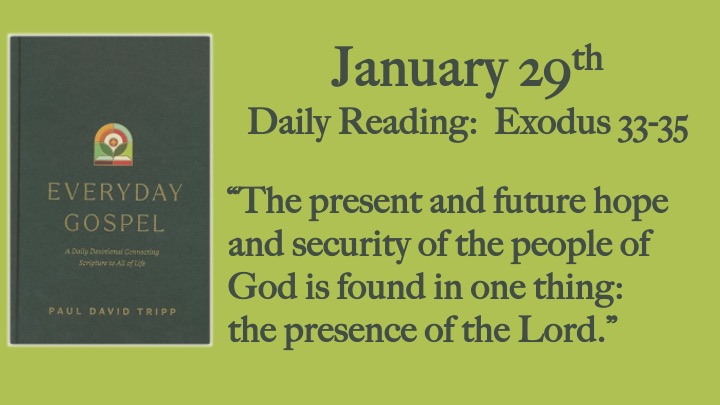
Krista, Jadyn, and I have been reading Everyday Gospel by Paul Tripp this year.

The daily devotionals have been a help in thinking about each daily reading through the Gospel.

Part of today's reading is Exodus 33:14 - 16.

And he said, “My presence will go with you, and I will give you rest.” And he said to him, ‘If your presence will not go with me, do not bring us up from here. For how shall it be known that I have found favor in your sight,  I and your people? Is it not in your going with us, so that we are distinct,  I and your people, from every other people on the face of the earth?”

Moses states that he would not go to the Promised Land if the Lord was not with him.  Tripp writes, "Moses understands that there is no hope for Israel and no reason for Israel to travel further if God doesn't go with them."

"[God] will go with us wherever we go and will do for us what we have no power to do for ourselves—not because we deserve it, but because he is generous in love and mercy.  It really is true that he is everything we need."

Today's Bible reading and devotional, the Psalm passage I preached on January 12, and what keeps coming up in Trinity's Daniel series is that our hope needs to be in the Lord.

Moses needed God more than the Promised Land.
Shadrach, Meshach, and Abednego needed God more than the king's approval.
Daniel needed God more than the safety given by this world.
Psalm 118:8 and 9 say, "It is better to take refuge in the LORD than to trust in man.  It is better to take refuge in the LORD than to trust in princes."

This hope in the LORD should affect how I pray, spend my time, interact with others, and do everything else in my life.


This Friday (1/31), I will be posting a summary of two 9Marks Church Questions books
"

2.26.2023

Gods Glory in Coffee Cups

As we wrap up this God's Glory in Our Story class, I pray it was an encouragement to those who attended and I pray those who attended would be an encouragement to others as they remember what we studies and talked about.

The outline for our last class was 

Personal - Coffee Cups
Biblical - Psalm 78:1 - 7
Historical - Two of J.C. Ryle's books Holiness and Practical Theology


Personal - Coffee Cups

Throughout the Bible, the people of God are given or create reminders of God's faithfulness and holiness.  A stack of stones, a meal, or a ritual.  When can do the same type of things.  I shared with the class a coffee cup reminder I have created in my office to show God's faithfulness to me since 1992.  

The eight mugs in the background represent some, not all, of the key places God has taken me in my life since I graduated from college.

  • Dominican Republic
  • Heritage Baptist Church
  • Baptist Bible College and Seminary
  • Emmanuel Baptist Church
  • Camp Patmos
  • OARBC 
  • Jamaica
  • InOnTime

Whatever coffee cups, life circumstances, you might have in the background, remember the quotes on the three mugs in the foreground.

  • "Preach the Gospel"
  • "Make Your Life Count, Make His Name Known"
  • "I will declare your steadfast love"
Biblical - Psalm 78:1—7

For similar verse graphics go to 
wiki.logos.com/Biblia_Verse_of_the_Day_images


Psalm 78:1–3.  Listen to God and listen to what your fathers have told you about God.

Psalm 78:4a.  Do not hide these things from your children.

Psalm 78:4b.  "But we will tell the generation to come the praises of the LordAnd His power and His wondrous works that He has done.

Psalm 78:5.  What does this verse mean when it says he has established a testimony?  I am reminded of how God begins the 10 Commandments.  They don't start with the commandments.  They start with a testimony of what God did.

Psalm 78:6. One of the reasons God did this is so that the next generations would know God and tell their children. 

Psalm 78:7 "so that they should set their hope in God and not forget the works of God but keep his commandments;

Historical - Two J.C. Ryle's books  Holiness and Practical Theology

We closed out this class session and series with the importance of prayer.

One of the chapters in Ryle's Practical Theology is on Prayer

Prayer is the most important subject in practical theology.

Here are seven plain reasons Ryle uses such strong language about prayer

  1. Prayer is absolutely needful to a man’s salvation.
  2. The habit of prayer is one of the surest marks of a true Christian.
  3. There is no duty in religion so neglected as private prayer.
  4. Prayer is that act in religion to which there is the greatest encouragement.
  5. Diligence in prayer is the secret of eminent holiness.
  6. Neglect of prayer is one great cause of backsliding.
  7. Prayer is one of the best receipts for happiness and contentment.

2.14.2022

Fear the Lord


Reeves' answer to his book's title 
What Does It Mean to Fear the Lord? is a good start. While it is a shorter version of a longer book. The book is Biblical and challenging. This difficult question is answered by explaining contrasting concepts like sinful fear vs. godly fear and righteous jealousy vs. selfish envy.

Reeves continually reminds the reader that the fear of the LORD is about the heart and passion not merely the head and knowing the facts. The book’s use of various Bible narratives, Psalms, and Proverbs grounds the ideas of the book in Scripture.
After reading the book, two thoughts came to mind.
  1. How can I live in godly fear? Personally, what heart changes need to happen in my life?
  2. How can I help others live in godly fear? What basic truths do I need to be communicating to others?
As I read the book, I was struck by how the fear of God needs to move me to live for him not run away from Him. Some of the points, such as the example of Exodus, which appears on page 20, seem like they could have been developed more. At the same time, this is the shorter version of a longer book answering the question and this question is one that can not be completely understood by imperfect humans.  It provides a great starting pointing to not merely think about the answer to this question but also to live out the significance of this.

I was provided a complimentary copy of this book through Crossway's Blog Review Program.

11.10.2021

An evangelist, a pastor, and a philosophy professor walk into...

An evangelist, a pastor, and a philosophy professor walk into a recital hall.

What you thought might have been the beginning of a bad joke was actually my Friday night.

A student at Calvin University and a member at Trinity Baptist Church invited me to share at an apologetics club meeting.  The topic was The Problem of Evil.  Below are the notes I put together.  While I didn't get a chance to share everything in this document and what I wanted to share, it is my prayer that in the ten minutes I had and in my answers during the Q&A time, God was glorified and the truth of scripture was spoken from my mouth.

Here are my notes from the night.

My name is David Rodgers.
I am the pastor of Children and Family and Adult Education at Trinity Baptist Church, near Knapp Corner.

I want to share a very quick, very open and honest, summary of my life to help you understand why I think it is important to think about this topic.

Growing up my dad spent time in a psychiatric wing of a hospital because of severe anger issues and my mom was hospitalized because of an eating disorder. She still struggles with the effects of this.

After graduating college, I lived in the Dominican Republic for 8 years through a MAJOR hurricane. When I first arrived in the D.R., living in a third world country was overwhelming

Until I visited Haiti, where life was even tougher.

I returned to the states in 2002 and two years later my dad died at 56, from lung/breathing issues

Four years ago, my family moved to Grand Rapids, from Ohio, for a ministry position. This position did not work.  I was in this role for only one year.

Then I worked in a warehouse for almost 3 years while I tried to figure out what I wanted to be when I grow up. Actually, ½ year was deciding if I wanted to be in ministry.  One year was sending out resumes and beginning the ministry search

AND then COVID hit

My mom was very sick in the hospital for about a month.  Some of that time she was on a ventilator.

These circumstances were hard, some very hard.
In each of them, there why moments when I cried out to God, “Why?”

Each of us has suffered, is suffering, will be suffering, and knows someone in any of those three states.

In my new role at Trinity Baptist Church, I pray I can help others look to God during the difficulties and “Why?” times of life.

I am not sure why you are here tonight.

You may be here because you are going through suffering right now and are looking for answers.

You may be looking for a good debate topic and this is a good one.

You may be trying to make sense of circumstances in this world and your life.

You may be questioning God’s goodness and power.

Whatever the reason, you are here, and I am thankful for that.

As a pastor in a local church, I want to share in a way that will help you think about God and prepare you to better handle the challenges of life, and help others do the same.

Let me clarify what I mean by that.
I hope my time here tonight will help Christians, I mean those who have repented of their sin, called out to Jesus to save them, and are trusting in Jesus Christ day by day, trust him more and more.

And help those who are not to consider who God is, who you are without him, and the necessity of trusting in Him in this broken, sinful world.

I am going to be referring to a couple of books and articles and will put more information at the end of this post.

The first quote is from a book that has been a blessing to me and my family for years.  The Gospel Primer contains reminders of what we have in the Gospel.

One entry is “Perspectives in Trials”

More than anything else could ever do, the gospel enables me to embrace my tribulations and thereby position myself to gain full benefit from them. For the gospel is the one great permanent circumstance in which I live and move, and every hardship in my life is allowed by God only because it serves His gospel purposes in me. When I view my circumstances in this light, I realize that the gospel is not just one piece of good news that fits into my life somewhere among all the bad. I realize instead that the gospel makes genuinely good news out of every other aspect of my life, including my severest trials. The good news about my trials is that God is forcing them to bow to His gospel purposes and do good unto me by improving my character and making me more conformed to the image of Christ.

Preaching the gospel to myself each day provides a lens through which I can view my trials in this way and see the true cause for rejoicing that exists in them. I can then embrace trials as friends and allow them to do God’s good work in me.

Question for you, what is the chief end of man?

The answer, man’s chief end is to glorify God and to enjoy him forever.

In talking with people about the Problem of Evil, the challenge is what do they believe about God. Here are a couple of statements about God we need to remember.

God is God and we are not.

God is Holy, which means not only that he is perfect but that he is also so “other” than us, different, separate.

God is to be worshipped and submitted to.

            God is to be glorified. Our worship is not like a microscope but rather a telescope.

What does a telescope do? It takes something huge, and so not of this world, and makes it more understandable, visible to us but it doesn’t completely represent the object being looked at.

            God glorifies himself. He is a jealous God.

            The difference between our jealousy and God’s jealousy is he deserves our worship.

            He deserves to be AND NEEDS TO BE IN THE CENTER OF THE UNIVERSE.

If this problem of evil debate is between believers, it is about worship, where is God.

If the is debate is between an unbeliever and believer, it is about the existence of God but really at the heart of the argument is worship.

I want to share ideas from a Gospel Coalition website article by Greg Welty, professor of philosophy at Southeastern Baptist Theological Seminary.

In sharing these thoughts from this short article taken from a 22-page journal article, I am not doing them justice.

If you have done any research, even a little, you probably saw these six statements in some form.

  1. A perfectly powerful being can prevent any evil.
  2. A perfectly good being will prevent evil as far as he can.
  3. God is perfectly powerful and good.
  4. So, if a perfectly powerful and good God exists, there will be no evil.
  5. There is evil.
  6. Therefore, God doesn’t exist.

Now the “problem” with this argument is in the second statement.

“A perfectly good being will prevent evil as far as he can.”

In the article, Welty writes…

We can argue that this premise is false:  Theodicy.

We can argue that no one can know this premise is true because no one can know enough to conclude that God doesn’t have a good reason for permitting evil:  Inscrutability.

“We cannot grasp God’s knowledge, the complexity of his plans, or the deep nature of the good he aims at in providence. And there is no proof that God does not have good reasons for allowing evil but because he is good can only assume that he does.”
We “can’t come p with God’s reasons, given who God is and who we are.”

I have shared from a devotional book and a philosophy professor.

Now I want to share from the Bible, our source of truth. Here are four passages.

Job 38 – 42.

In my Bible, there are two titles given to these sections “The Lord Answers Job” and “The Lord Challenges Job”

With one small section 40:3-5, entitled “Job promises silence.” Let me read that.

 Go home tonight and circle the question marks in Job 38 – 42.


The Story of Joseph

In Genesis 50, Joseph’s brothers come to him fearful that Joseph would have his revenge after their father died. They worked out a formal statement of apology.  What was Joseph’s response?

“Do not fear, for am I in the place of God?  As for you, you meant evil against me, but God meant it for good [an even greater good than my good], to bring it about that many people should be kept alive, as they are today.  So do not fear, I will provide for you and your little ones.”  Thus, he comforted them and spoke kindly to them.


Jeremiah 29:11

Do you know who this verse is written to?

This well-known verse is written to Jewish exiles in Babylon.

Do you know what the verse immediately before this verse says?

“For thus says the Lord:  When seventy years are completed for Babylon, I will visit you, and I will fulfill to you my promise and bring you back to this place.  For I know the plans I have for you…”

I would remind high school and college senior classes of this context before they picked this as their class verse.

The big idea is not “God has big plans right now for me.”

The big idea is “I am going to trust God’s plans now and for the next 70 years and beyond because of who he is not because of my circumstances.”


Romans 8:28      

The "good" in verse 28 is not the easy life with no troubles.

Verses 29 says is conformity to the image of God.


As you read through different Christian writers you will see different approaches to the problem of evil (logical, evidential, existential) and different responses to the problem of evil (Free Will Model, Soul-Making Model, Possible Worlds, Suffering of God, Mystical, Narrative)

In what I shared with you tonight, in pastoring my church family, and in the narrative of scripture, I believe the “greater good” response best demonstrates a high view of God and understanding of the Biblical narrative and Biblical theology.   

“So many traditional treatments of the problem of evil assume that God’s ultimate purpose is to provide happiness for man and that is not so. God’s ultimate purpose is to glorify himself.”  Christensen.


Resources referenced in my notes.

A Gospel Primer by Milton Vincent

The Problem of Evil by Greg Welty, www.thegospelcoalition.org/essay/the-problem-of-evil/

What About Evil? A Defense of God's Sovereign Glory by Scott Christensen


9.11.2021

September 11 2021

20 years ago.

I know there are a lot of documentaries, articles, and posts out about the 20th anniversary of 9/11 and this is just one more.

Below, by the book cover, is a post I wrote 5 years ago about 9/11, a specific book, and God's providence.
Since I wrote this some significant things have happened generally and personally. 

  • A couple of challenging ministry transitions including a move from Ohio to Michigan
  • The release of the book Dark Clouds, Deep Mercies (A post about this book)
  • The COVID-19 virus 
  • A new, exciting ministry opportunity at Trinity Baptist Church.
I am very thankful that the truth of Isaiah 26:3, 4,
 
You keep him perfect peace 
whose mind is stayed on you,
because he trusts in you.
Trust in the LORD forever,
for the LORD God is an everlasting rock.

was true 20 years ago, is true today, and will remain true.

As I think about these years, I am thankful for God's word and am also thankful for how God has used specific people at specific times...
David Ryan's gift of a great book
Rick York's leadership at Santiago Christian School
Bob Flamm's leadership at Emmanuel Christian School
Pastor Duke's preaching at Emmanuel Baptist Church
Lyle Fortney and Jim Soss's examples of living for God in the midst of hard times.
and so many other people.

I am so thankful that God's glory is made known to me...
in His Word
in His Son
in the testimony of Godly men and women
through Bible-based, God-glorifying books and
in the circumstances of life.

Previous Blog Post:


I want to tell you about a great book and the impact it has had on my life.
There is a great book on the fruit of affliction and suffering called The Hidden Smile of God.  You can download a free copy of the book by clicking HERE.
With Pastor Duke's recent sermons on suffering (Suffering is the Pathway to Glorification The Weight and (Wait) of Glory) Jim Soss and Lyle Fortney's testimony video and EBC's upcoming "God Healing for Life's Losses" conference,   I have been thinking about suffering and the glory of God.  When I think about this topic, I am reminded of The Hidden Smile of God.

First of all I want to let you know about the book.  So I took some quotes from the Desiring God website.
Bunyan. Cowper. Brainerd.
John Bunyan suffered long-term imprisonment, even when a simple promise to cease preaching would have freed him, and he was moved to rely on God even more. Despite month after month of debilitating depression, William Cowper’s poetry reflected the sustaining character of God and led him to worship more deeply. David Brainerd so desired to honor God that, through the loneliness of wilderness ministry and the agony of tuberculosis, he pressed on, transforming world missions forever.
For John Bunyan, William Cowper, and David Brainerd, the loving purpose of God in pain was one of the most precious truths in the Bible and one of the most powerful experiences of their lives.
Now let me tell you some personal stories in how God has used The Hidden Smile of God in my life to remind me of God's glory in the midst of suffering.
2001.
I received my FIRST copy of The Hidden of Smile of God almost 15 years ago.  I don't remember the exact date I received many books BUT this one I do.  It was September 11, 2001.  I was teaching in the Dominican Republic.  We received mail once a week, on Tuesdays.  The pilots who brought us our mail had to stay in the Dominican Republic because flights were cancelled.  I remember receiving this book on suffering from my brother-in-law on one of the biggest days of suffering in my lifetime.  Seeing the news stories.  Wondering what was happening.  We taught students from all over the world.  The Dominican Republic, South Korea, Germany, Italy and Canada.  Many of them came to school to let us know that they loved us and our country and they wanted to help us if needed.  It was hard to process everything going on, especially being outside of the United States but God used this book of biographies to help me think through suffering and God's glory.
2005.
Spring ahead about four years.  Christmas, 2005.  The mercury fire at Emmanuel Christian School.  A couple of students vandalized the school where I taught.  This resulted in a fire that "mercurized" - a word made up by that year's senior class - the high school.  Krista and I lived in a small apartment so I had all of my books including my FIRST gift copy of The Hidden Smile of God in my classroom.  My books were in my classroom with no obvious damage but they were "mercurized."  Unusable.  I saw all of my books and other classroom things on a video but would not be able to have any of it.  I lost my September 11th copy of The Hidden Smile of God along with so many other precious items like a file of encouraging notes from friends and family.  What was especially hard was there were many notes from a good friend of ours in the Dominican Republic - Heidi Goodbar, a creative, artistic, encouraging co-teacher who died from cancer.
Someone suggested that I write Desiring God about the fire and losing several books, including The Hidden Smile of God.  I did and they blessed me by sending me the books I lost in the fire along with a couple of other books.  So I received my SECOND copy of the book.  It was not signed by my brother-in-law and it wasn't received on the day of a national tragedy.  Another blessing during this time was watching Bob Flamm, the teachers and the students work together that second semester to finish the year well despite very challenging circumstances.
2016.
As I think about my SECOND copy of The Hidden Smile of God and as I think about Jim Soss, Lyle Fortney, Heidi Goodbar, and many others who have suffered or are suffering through the circumstances of life, I am so thankful for the Hidden Smile of God, not Piper's book but rather God's providence written about in William Cowper's hymn "God moves in a mysterious way."
God moves in a mysterious way
His wonders to perform;
He plants His footsteps in the sea
And rides upon the storm.
Deep in unfathomable mines
Of never failing skill
He treasures up His bright designs
And works His sovereign will. 
Ye fearful saints, fresh courage take;
The clouds ye so much dread
Are big with mercy and shall break
In blessings on your head. 
Judge not the Lord by feeble sense,
But trust Him for His grace;
Behind a frowning providence
He hides a smiling face. 
His purposes will ripen fast,
Unfolding every hour;
The bud may have a bitter taste,
But sweet will be the flower. 
Blind unbelief is sure to err
And scan His work in vain;
God is His own interpreter,
And He will make it plain.
For more about William Cowper's life read The Hidden Smile of God or at least read Tim Challies' article about William Cowper.

I am so thankful that God's glory is made known to me...
in His Word.
in His Son.
in the testimony of Godly men and women.
through Bible-based, God-glorifying books and 
in the circumstances of life.

3.22.2021

Challenges from Lead

Reading Lead by Paul Tripp has been a blessing because I took a different approach to reading this book.  I slowly went through the book.  This helped me think about what each chapter was about and what I needed to learn and/or remember about each topic.  
Part of this reflection time included writing a general, leadership prayer for each chapter.  I put the links for each prayer below.  
Another part of this reflection time was a more personal prayer.

The following two quotes helped me think about the theme of this book.
"Because we are not sovereign over the situation in which we minister, because we have no power to change people's heart, because we are often in the way of instead of being part of what God is doing, because we cannot predict the future, we have no ability on our own to achieve ministry growth or success." 
"Ministry success is a testament to who God is and what he is willing to do through us by grace."
Ministry leaders need to have a ministry team helping one another through, not just this specifically rough time, but even so times of blessing AND challenge.  I would recommend church and ministry leaders read this book.  It will be a blessing and a challenge.

  1. Achievement
  2. Gospel
  3. Limits
  4. Balance
  5. Character
  6. War
  7. Servants
  8. Candor
  9. Identity
  10. Restoration
  11. Longevity
  12. Presence


Introducing 'Lead' by Paul David Tripp from Crossway on Vimeo.

3.21.2021

Glory of God Culture


A prayer I wrote using quotes from chapter 12 -  Presence - Paul Tripp's Lead:  12 Gospel Principles for Leadership in the Church

Lord, God, the one who has everlasting dominion and does what he wants,

Don't let me forget your presence, Lord.  Fill the eyes of my heart and help me see the glory and presence of the one who created all of creation and controls it to this day.  Every good thing is the work of hands greater than your own, including the ministry you give me.

May I find my confidence in you and not in myself and never quit reminding myself of your presence and glory.  I don't want to quit doing what I'm doing out of allegiance to you, Lord, and love for others and do it for me.   Lord, don't allow me to take too much credit for the results of your ministry.  Ministry success is a testament to who you are, God. 

Thank you so much for your rescuing mercy especially when it all seems to be crashing down, when sin is exposed or where ministry leadership is taken away.

God, your presence is my hope, my confidence, my refuge, my courage, 
Your presence calls me to humility and dependency.
Your presence is a constant motivation to continue.

Amen!


Bad things happen to a ministry leader and to a leadership community when ministry leadership works so commands focus that they begin to functionally forget the presence of the Lord.  (211)

Leading a ministry without the presence of the Lord filling the eyes of your heart is dangerous for any leader or leadership community.  If it's possible to look at creation and not see the glory and presence of the one who created it all and controls it to this day then it is also possible to look at your ministry and forget that every good thing is the work of hands greater than your own.  (212)

Every human being is glory-oriented because that orientation is meant to drive us to God.  (214)

For ministry leaders, success is more spiritually dangerous than failure, much power rather than no power tempts us to dominate, acclaim is more of a potential spiritual pitfall than rejection, and seasoned experience carries with it more temptation than the unknowns of starting out.  (215)

There is too much confidence in self and self-importance among us.  (215)

We must never quit reminding ourselves of God's presence and glory lest we quit doing what we're doing out of allegiance to him and love for others and do it for ourselves.  (216)

We ministry leaders are given way too much credit for the results of our ministry, and we should all resist it.  People tend to think that we have way more power and wisdom than we actually have.  Ministry success is a testament to who God is and what he is willing to do through us by grace.  (216)

God will not surrender his glory to another.  He is not willing that we take credit for what he alone can do.  (217)

Those moments when it all comes crashing down, when sin is exposed or where ministry leadership is taken away, are not judgment but rescuing mercy.  (217)

This glory-of-God culture is protection against self-glory and will keep us from taking credit for ministry success we could never produce on our own.  (217)

The men of Israel are afraid not just because Goliath is big and powerful, but because they are forgetful.  (218)

Effective, long-term ministry leadership takes courage. (220)

As a ministry leader, God's presence is your hope, God's presence is your confidence, God's presence is your refuge, God's presence is your courage, God's presence calls you to humility and dependency, and God's presence is your constant motivation to continue.  (221)

Ministry leadership, at hit core, is about a community of leaders practicing together the presence of the Lord.  (221)


3.18.2021

Not as mature as I need to be


A prayer I wrote using quotes from chapter 11 - Longevity - Paul Tripp's Lead:  12 Gospel Principles for Leadership in the Church

Lord God, 

Remind me that there is no such thing as an individual ministry.  Any ministry I am a part of is a community project.  I need the ministry of others in order to grow as a leader.  Bring people into my life and ministry that will stand in the way when I am going to make a bad choice.

Personally, grow in me a holy discontentment.  Never let me think that I am as mature as I need to be.

In community, help me be an agent of comfort you and to be comforted by others.

While we haven't been in places for a long time, I  pray that I, and my family, would be growing in maturity.  God, use me, wherever I am, to produce lasting gospel fruit.  I don't merely want to endure a ministry.

Your mercy, God, is the one thing that stands as the reason for any ministry.  May your mercy and my weakness cause me to run to God's grace for moment-by-moment help.  I want to be humbled by the Gospel, made courageous by the gospel, and infused with sturdy hope by the gospel.

God, thank you for giving me what I need in order to be what I'm supposed to be and to do w and to do what I am supposed to do right now, right now.

Amen!

This was a particularly challenging chapter to read and prayer to write, especially because I was at my last ministry for only one year.  I would very much appreciate your prayers during this time of ministry searching and personal examination.  Thanks!


Gospel seeds need time to mature and grow, and the key to longevity is spiritual maturity because weeding and watering the garden that is the church is such hard work.  (194)

Every leadership community needs to understand that there is no such thing as individual ministry.  Every leader's ministry is a community project.  Every leader needs the ministry of other leaders in order to grow to the kind of maturity that will allow him to lead well over the long term and end well.  Every leader needs leaders who will stand in his way when he is about to choose the wrong way.  (194)

Longevity is the fruit of spiritual maturity is the result of longevity, and both are the fruit of the gospel community.  (194)

Every ministry leadership community should value and plan for longevity, which means every ministry leadership community must value and plan for spiritual maturity.  (196)

No leader should be considered as mature as he or she needs to be.  (196)

God makes his invisible comfort visible through agents of comfort he sends where comfort is needed.  Gospel community is intended by God to be incarnational, where we are to one another the look on God's face, the touch of his hands, his words, and his presence.  (197)

Too many leaders fail to experience the joyful fruitfulness of ministry longevity.  And let me say here that ministry longevity is not just about hanging in there for a long time but about growing in maturity and because there is growth in maturity, there is an increasing harvest of long-term fruit.  It's more than endurance; it's endurance that produces lasting gospel fruit.  (197)

There would be no kingdom of God, no church of Jesus Christ, no people of God, and no population in the new heavens and the new earth if it were not for the infinite patience of the Lord.  (199)

Redemption is longevity work.  (199)

Strategizing for ministry longevity means responding with patient grace in the face of a leader's spiritual immaturity, seeking to be part of God's work of rescue and transformation.  (200)

Paul says that there is only one thing that stands as the reason he has this ministry:  God's mercy.  (201)

Weakness in a ministry leader is not in the way of a vibrant ministry life but is a vital ingredient of it if that weakness causes him to run to God's grace for moment-by-moment help and to be open to the ministry of others.  (202)

There is no fear of man or the circumstances that would cause him to compromise the confrontation, comfort, or call of the gospel in any way.  (202)

Spiritual maturity in the life and ministry of a ministry leader is about being humbled by the gospel, made courageous by the gospel, and infused with sturdy hope by the gospel.  (203).

In order to lead, we need to be rescued daily from ourselves.  As leaders, we are not as humble or as courageous or as hopeful as we could be by grace.  (203)

You cannot grieve what you do not see, you cannot confess what you haven't grieved, and you can't repent of what you haven't confessed.  (204)

In a spiritually healthy leadership community, confession isn't unusual and awkward but a regular part of its culture of grace.  (205)

If confession is the result of eys that now see and a heart that is grieved, it will be followed by a desire for rescuing and transforming grace.  (205)

God has already given every one of us everything we need to be what we're supposed to be and to do what we're supposed to do right here, right now.  (206)

3.15.2021

Agents of God's restoring mercy


A prayer I wrote using quotes from chapter 10 - Restoration - of Pau Tripp's Lead: 12 Gospel Principles for Leadership In the Church

Lord, the One who restores us, 

Thank you for the restoration work you have done, are doing, and will continue to do in my life.   

I pray that no matter the circumstances, my heart would be turned to you because that is what is right.  As I think about your forgiving, restoring, and delivering grace, I am utterly amazed.  Help me and the leadership communities I am part of to always trust in your restorative grace.     

Help me not make assumptions about the leaders I work with.  I don’t want to make assumptions about the spiritual conditions of leaders and at the same time, I don’t want to be passive.  Help me represent a restorative heart to my fellow leaders and the church. 

I want to be used, when needed, as an agent of God’s restoring mercy.  God help me to better understand that restoration is about glorifying you not getting back to a specific job or ministry position.

I pray that my confessional theology and functional theology would be the same.  Just because I am doing well in my assigned ministry does not mean I am spiritually where God wants me to be.


quotes


Even if sin necessitates a leader's removal from his position and ministry duties, turning toward him with grace is always right. (179)

We sinners don't just need forgiving grace; we need restoring grace.  And we don't just need restoring grace; we need delivering grace.  (179)

It is beautiful to see the power of restorative grace up close and personal, and it is sad to see that so many leadership communities don't actually trust its power when a key leader's sin has been revealed by the divine restorer.  (179)

Every church or ministry leadership community must be a restorative community if it's going to have long-term spiritual health and ministry effectiveness.  (180)

If it is true that every leader is in the middle of the ongoing work of God's sanctifying grace, then it is also true that there is still the presence of remaining sin in every leader's heart. (180)

Ministry effectiveness is not to be confused with the cleanness of the heart.  (181)

Assumptions that a leadership community makes about the spiritual condition of its leaders, assumptions that allow the community to passive rather than pastoral, result in a shocked and unprepared community when a fellow leader falls in some way and needs restorative care.  (181)

Every leadership community has moments when they are called to be agents of God's restoring mercy.  (181)

Every leadership community should commit to representing, in their leadership culture and relationships, the restorative heart of the Redeemer.  (183)

If we think it's possible to escape God's presence, we have gone spiritually insane!  (184)

By cultural identity, he is a God-fearer, but in terms of his response to God's call, he doesn't act like someone who fears the Lord.  In this way, his words confront us with the difference that may exist in a leader between his confessional theology and his functional theology.  (185)

Restoration is much deeper and more foundational than doing what is necessary to quickly get a leader back into his ministry position.  (186)

Restoration that isn't heart deep sets up that leader and his community for further problems because the core of the problem, the leader's heart, has not been restored to where God designed it to be.  (187)

We should not assume that because a leader is still doing his assigned ministry duties that he is spiritually where God wants him to be.  (188)

Restoration never minimizes the damaging reality of sin, but while it takes sin seriously, it also believes in the power of restorative grace.  It believes in God's power to turn a heart and rebuild a life.  (189)

No leader is impervious to temptations, because no leader is sin-free and sanctification-finished.  Not one.  (189)

So every leadership community needs to be committed to, and prepared for, those said and difficult moments when the Savior calls them to a restorative agenda.  (190)

We cannot be so protective of the institution, the church, that we discard leaders and members of the church as if they're broken and no-longer-needed commodities.  (190)